






















This financial metric is typically listed on a company’s balance sheet and is commonly used by analysts to determine the company’s overall fiscal health. When calculating the shareholders’ equity, all the information needed is available on the balance sheet – on the assets and liabilities side. bookkeeping and payroll services The total assets value is calculated by finding the sum of the current and non-current assets.
How to calculate equity
Your equity has increased as the value of your home has risen and as you’ve paid down the mortgage. In Double-Entry Accounting, there are at least two sides to every financial transaction. Every accounting entry has an opposite corresponding entry in a different account. Along with Equity, they make up the other side of the Accounting Equation. You can think of them as resources that a business controls due to past transactions or events. ROI is broader in scope than ROE and can be used to evaluate the efficiency of various types of investments, not just those funded by equity.


How is the balance sheet valuable formula for financial analysis?

The asset equals the sum of all assets, equation for equity i.e., cash, accounts receivable, prepaid expense, and inventory, i.e., $234,762 for 2014. The asset equals the sum to all assets, i.e., cash, accounts receivable, prepaid expense, and inventory, i.e., $305,483 for the year 2018. Shareholder equity is held through shares of a company, whether through shares of private equity or stockholders’ equity through a company’s stock.


How to Calculate Shareholders’ Equity

In closing, the owner’s equity value was derived after considering the initial investment, accumulated profits, withdrawals made by the owner, and the company’s liabilities. Therefore, the net difference between the total assets belonging to a business and total liabilities reflects the concept of owner’s equity. Equity can also be an important concept to https://feriasnaflorida.com.br/2024/03/19/best-5-payroll-software-for-small-business-in-2025/ understand just in your own finances.
- The capital asset pricing model, however, can be used on any stock, even if the company does not pay dividends.
- The accounting equation is based on the premise that the sum of a company’s assets is equal to its total liabilities and shareholders’ equity.
- Shareholders’ equity represents the net worth of a company—the dollar amount that would be returned to shareholders if a company’s total assets were liquidated and all its debts were repaid.
- For this reason, it should be considered alongside other financial metrics and the company’s overall prospects.
- Understanding the equity equation is critical from an investor’s point of view.
- Depending on the type of share or stock sold, the buyer may be entitled to dividend payments or voting rights.
Fidelity Smart Money℠
- If you are a business owner, it is important to regularly assess the financial health of your company.
- Common liabilities include accounts payable (money the business owes to suppliers), loans, and unearned revenue.
- This account builds up over time and gives a long-term view of how well the business is retaining profit.
- Equity refers to the residual interest in the assets of a company after deducting its liabilities.
- Such industries include banks, financial institutions, and insurance firms.
- Investing in equity ownership is riskier than investing in other financial instruments.
- Here total assets refer to assets present at the particular point and total liabilities means liability during the same period.
However, if you’re paying dividends, you’re committing to paying shareholders based on business performance. If the business starts generating more profit, you’re paying more in dividends. Equity is sometimes used as an alternative to debt financing for injecting money into a business. One isn’t inherently better than the other—knowing which one is right for you requires understanding the differences.
ROE vs other financial performance measures
In the stock market, shareholders’ equity (or owners’ equity for privately held companies) represents the difference between a company’s assets and liabilities. If all of the company’s assets were liquidated and used to pay off debts, the shareholders’ equity is the amount that would be left over. In the case of an acquisition, it is the value of company sales minus any liabilities owed by the company that are not transferred with the sale.

However, if a company has a net loss or negative shareholders’ equity, calculating the ROE is not worthwhile. Since repurchased shares can no longer trade in the markets, treasury stock must be deducted from shareholders’ equity. Often referred to as paid-in capital, the “Common Stock” line item on the balance sheet consists of all contributions made by the company’s equity shareholders.
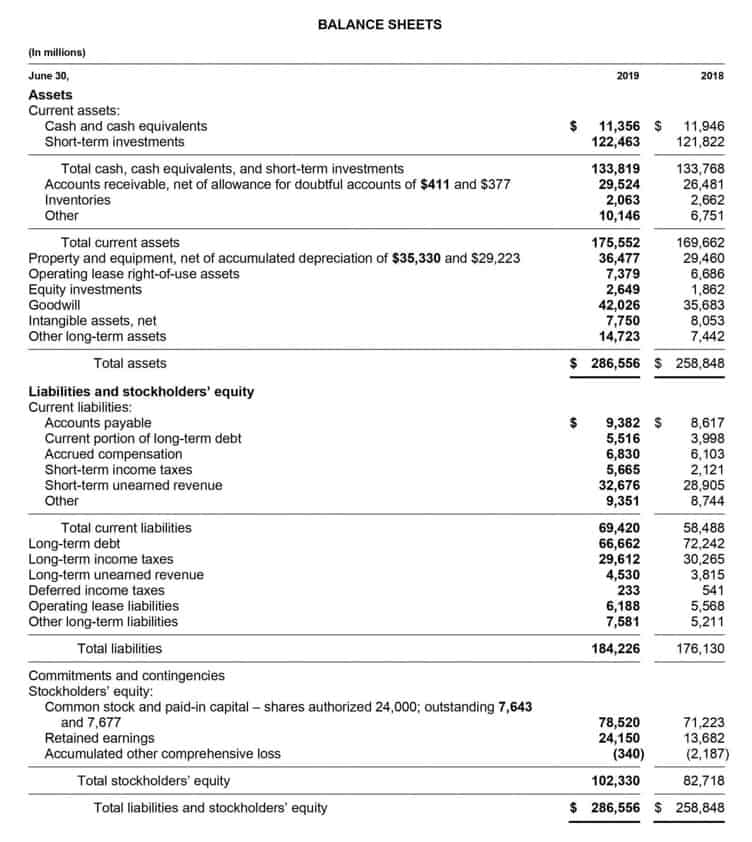
Assets are resources controlled by the company that are expected to provide future economic benefits. Examples include cash held in bank accounts, buildings and land owned by the business, equipment used in operations, and inventory available for sale. A liability, in its simplest terms, is an amount of money owed to another person or organization. Said a different way, liabilities are creditors’ claims on company assets because this is the amount of assets creditors would own if the company liquidated.